
Commercial Disinfecting and Sanitizing Services in New York
Shared commercial spaces contain surfaces touched by employees, customers, patients, students, tenants, and visitors throughout the day. Door handles, elevator buttons, restroom fixtures, counters, shared controls, and equipment may need more than routine cleaning.
CleanCru provides commercial disinfecting and sanitizing services for offices, medical facilities, schools, gyms, retail spaces, and event venues throughout Manhattan, Brooklyn, Queens, the Bronx, and Metro New York.
Cleaning, Sanitizing, and Disinfecting Are Different
Cleaning, sanitizing, and disinfecting are related but separate processes:
Cleaning
Physically removes dirt, residue, and many germs from a surface.
Sanitizing
Reduces germs on a cleaned surface to levels established by applicable public-health requirements.
Disinfecting
Uses a registered chemical product to kill or inactivate specified germs when applied according to its label.
According to current CDC guidance, surfaces should generally be cleaned before they are sanitized or disinfected. Dirt and grime can prevent a chemical product from making proper contact with the surface.
CleanCru uses applicable EPA-registered disinfectants according to their labels. Products must be compatible with the surface and approved for the intended use. Required dilution, protective equipment, ventilation, application method, and contact time vary between products.
Important distinction: The accurate term is EPA-registered, not EPA-approved. The EPA registers disinfectants and approves specific claims and instructions on their labels.
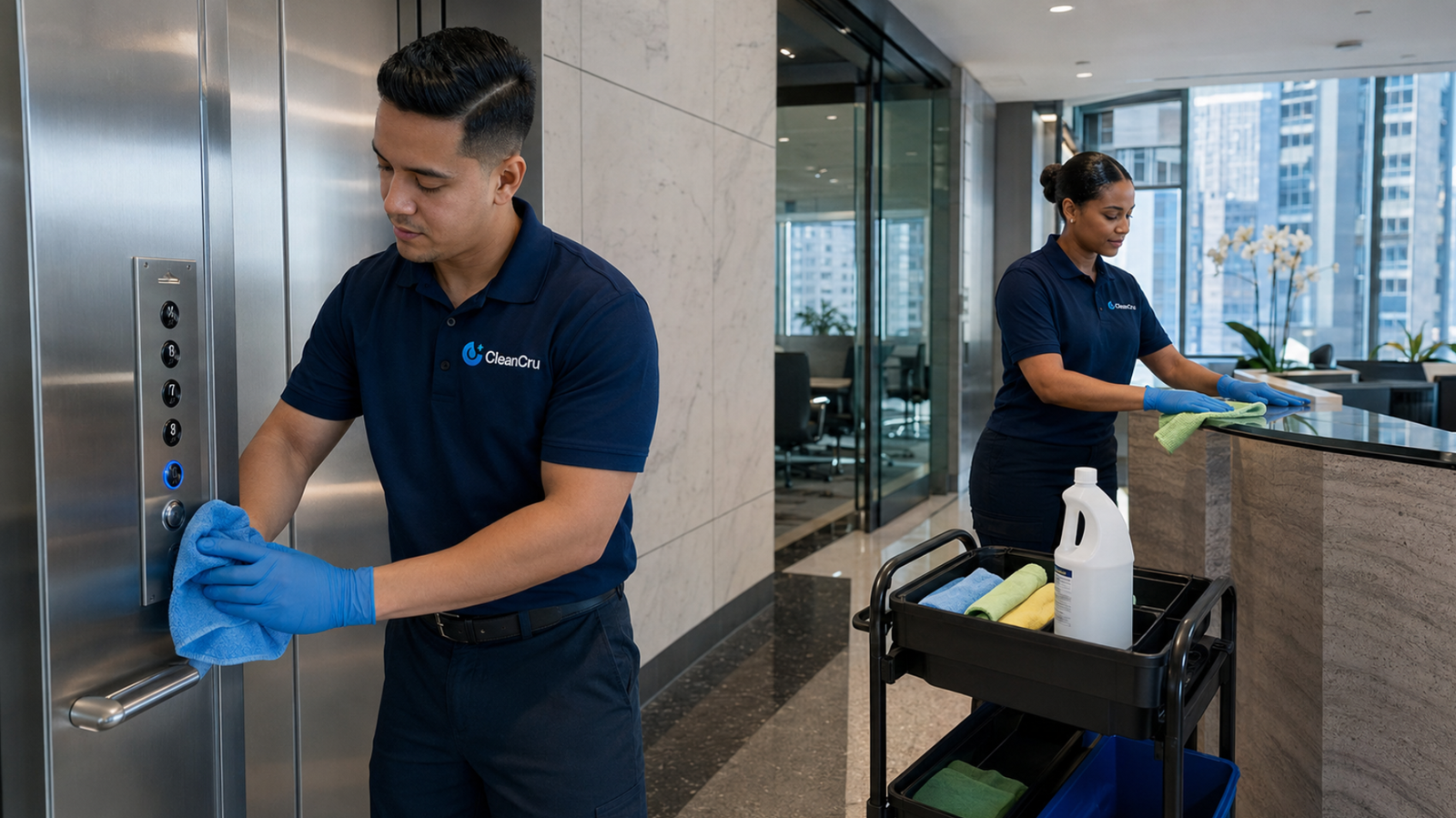
Commercial Disinfection Protocols and High-Touch Cleaning
Effective disinfection protocols involve more than spraying and immediately wiping a surface. The area must first be cleaned when visibly dirty, and the selected disinfectant must remain wet for its complete labeled contact time. A commercial service scope may include:
On claims: Requests described as virus and pathogen cleaning must be matched to the organisms and use sites listed on the disinfectant label. No product should be represented as effective against a particular virus, bacterium, or fungus unless the EPA has reviewed and approved that claim.
Preventive disinfection may be incorporated into a facility's maintenance and care plan when appropriate, but it cannot guarantee that illness or transmission will never occur.
Disinfecting Offices, Classrooms, Restrooms, and Shared Spaces
Not every facility requires the same cleaning frequency or disinfection process. A private office has different needs from a medical waiting room, classroom, gym locker room, coworking space, or busy retail property. High-touch areas may include:
- • Door handles, push plates, and railings
- • Light switches and shared controls
- • Elevator buttons and access panels
- • Reception counters and shared desks
- • Conference tables and office equipment
- • Restroom fixtures, partitions, dispensers
- • Break-room counters and appliance handles
- • Classroom tables and nonporous surfaces
- • Fitness-studio handles and equipment touchpoints
Classroom and office cleaning may combine routine dust removal, trash collection, vacuuming, restroom sanitization, and targeted disinfection. Medical and healthcare facilities require a facility-specific plan based on their rooms, surfaces, patient activity, and internal infection-control policies.
Standard commercial disinfection does not replace clinical protocols, regulated-waste procedures, or specialized laboratory cleaning requirements.
Build a high-touch disinfection plan for your facility.
Customized Commercial Cleaning and Disinfection Programs
Disinfection can be scheduled as a one-time service, added to recurring office cleaning services, or incorporated into janitorial cleaning services. Available scheduling may include daytime service, overnight cleaning, night cleaning, or another approved window that minimizes interference with the facility.
For properties that already use day porters or day porter services, targeted disinfection can be scheduled around their regular maintenance responsibilities. The approved service scope should clearly identify which provider handles routine cleaning, restroom sanitization, consumable supplies, and chemical application.
Surface disinfection may also be coordinated with:
Not the same process: Carpet cleaning, hardwood floor care, tile and grout restoration, ceiling-tile cleaning, high-speed burnishing, power washing, and construction-debris cleanup are separate processes. They should not be confused with high-touch surface disinfection.
Not automatically included: Electrostatic fogging disinfection, antimicrobial spraying, and similar application methods. Ask whether a product label permits the proposed method and whether it's appropriate for an occupied commercial facility.
Separate services: Air exchanging, HVAC cleaning, and HEPA air scrubbers address air or mechanical systems rather than routine surface disinfection. These require a separately qualified provider and should not be represented as part of standard office cleaning.
Disinfecting Costs and Frequently Asked Questions
Pricing depends on square footage, facility type, number of high-touch surfaces, required products, cleaning frequency, operating hours, and building access. Disinfection may be quoted separately or incorporated into a recurring commercial cleaning program.
Ask which EPA-registered products will be used, which organisms appear on the label, whether the products are compatible with the facility's surfaces, how contact times are followed, and which areas are included in the service scope. Also ask about insurance coverage, technician training, standard operating procedures, communication, scheduling, and how service concerns are handled these should be verified directly rather than assumed from advertising.
Service may be scheduled before opening, after closing, overnight, or during another approved period. Occupancy restrictions depend on the disinfectant label, ventilation, application method, and facility requirements.
No. Electrostatic application is one method of distributing certain products. It does not replace cleaning, and it should only be used when the disinfectant label permits that application.
No. Standard disinfection does not automatically include biohazard or crime-scene cleanup, mold damage, water damage, chemical residue, tear gas, pepper spray residue, document restoration, or hazardous-waste removal. Those situations require specialized restoration technicians and separate procedures.
No company should promise complete or permanent pathogen removal. Results depend on the organism listed on the product label, correct dilution, surface compatibility, complete coverage, and proper contact time.
Request Commercial Disinfecting Services in New York
CleanCru provides professional cleaning and targeted disinfecting for businesses throughout the New York area. Request a free quote to develop a customized disinfection program for your facility.