
A practical guide for business owners and building managers comparing cleaning companies in New York City: what to ask, what to put in writing and which red flags to avoid.
Hiring the best commercial cleaning company in NYC is less about the lowest price and more about fit. The wrong company means missed tasks, rotating crews and constant follow up. The right one becomes part of how your building runs, with clean restrooms, stocked break rooms and a team you never have to chase.
This guide walks business owners and building managers through the questions to ask, the scope to put in writing, how pricing works and the red flags to watch for. Use it to compare cleaning companies side by side, whether you manage an office, a medical suite, a retail space or a multi tenant commercial building.

The best cleaning companies start with a walkthrough, not a phone quote. They measure the space, look at floor types, count restrooms and break rooms, ask about foot traffic and write a scope that lists every task and how often it happens.
They also assign a consistent crew and a single point of contact. When the same people clean your space every night, they learn your layout, your alarm procedure and your preferences, and quality improves without anyone having to micromanage.

A real quote needs a real look at the space. Be cautious of any company that gives a firm price over the phone without seeing square footage, floors and restroom count.
Consistency is the biggest driver of quality. Ask how crews are assigned and what happens when someone is out.
Ask for a written checklist covering offices, break rooms, restrooms, glass, trash and recycling, and floors, with the frequency for each task.
Look for a named supervisor or account manager who inspects the work and answers when something is missed.
Building management often requires a certificate of insurance. A professional company provides it without hesitation.
Ask how quickly a missed task is fixed and how to reach someone after hours.
A good company adjusts frequency and scope as your needs change instead of locking you into a rigid contract.
A strong scope lists tasks by area. For offices that means desks and common areas dusted, trash and recycling removed, break rooms and kitchens wiped down and restocked, restrooms cleaned and disinfected, interior glass and glass doors cleaned, and floors vacuumed, mopped or scrubbed.
It also lists periodic work on a calendar, such as carpet cleaning, floor stripping and waxing, and deep cleaning. See how we describe our office cleaning services in NYC and janitorial services for examples of a complete scope.

Offices need quiet, reliable nightly cleaning. Medical offices need disinfecting protocols and records of what was done, so look for experience with medical office cleaning. Retail and restaurant spaces need floor care and fast cleaning before opening, and warehouses need general cleaning, trash removal and safe floors.
For a multi tenant commercial building, ask whether the company can handle lobbies, common areas and tenant spaces under one contract. Our property management cleaning services are built for exactly that.

When you compare cleaning services, line up the same items for each company: office cleaning services, restroom cleaning, janitorial service for common areas, floor care, and deep cleaning and sanitization. Then compare the cleaning plan and the cleaning schedules. A good plan states which tasks happen nightly, weekly and monthly, so nothing slips between visits.
Flexible scheduling matters in NYC. Ask whether the company can shift to early morning, overnight or weekend visits, and whether it can add a day porter for high traffic areas. Companies that offer flexible cleaning schedules make it much easier to adapt when your office hours or headcount change.

Facility managers need a cleaning company that behaves like a building service partner. That means one contact who answers quickly, a supervisor who checks the work, professional cleaners who are trained and uniformed, and customer service that responds when something is missed. Ask how complaints are logged and how fast they are fixed.
Office buildings and multi tenant properties also need clear rules for cleaning supplies, green cleaning products and access. Ask whether the company uses green cleaning products where your building requires them, and whether it handles specialty work such as post construction cleaning and commercial carpet cleaning so you do not need another vendor for each task.

Office buildings need quiet nightly cleaning and restocked break rooms. Retail stores need floor care and fast, thorough cleaning before opening, which is why companies with retail cleaning experience tend to deliver better results for shops and restaurants.
Medical facilities need stricter routines for waiting rooms, exam rooms and restrooms, with the right disinfectants and records of each visit. Ask any company you are considering to describe, step by step, how it would clean your specific kind of space.

If one bid is much lower, something is missing: fewer visits, a thinner scope or an unsupervised crew. Compare scope first, price second.
If tasks and frequency are not in writing, you will argue about what was included the first time something is missed.
High turnover means you are retraining a new person every month and security becomes harder to manage.
Never let a crew into your building without a current certificate of insurance on file.
Be careful with multi year contracts and heavy cancellation penalties before the company has proven itself.
If nobody answers when a problem comes up at night, small issues turn into big ones by morning.
Cleaning companies in New York City usually price by the visit, the month or the square foot, depending on the type of space. The main drivers are square footage, visit frequency, floor types, the number of restrooms and break rooms, and any extras such as carpet cleaning or floor refinishing.
Whatever the pricing model, ask for it in writing with every task listed. That is the only way to compare quotes fairly, and it is why we only quote after an in person walkthrough. Read more about how our commercial deep cleaning and floor care are scoped.

Ask for a certificate of insurance, how workers are trained and how chemicals are handled. A professional company follows OSHA hazard communication rules, keeps safety data sheets on file and uses EPA registered disinfectants where disinfecting is part of the plan.
Building management may also require specific coverage amounts, named insured language or green cleaning products. Raise these at the start so the company can confirm it meets them. See our disinfecting and sanitizing services for how we approach this.
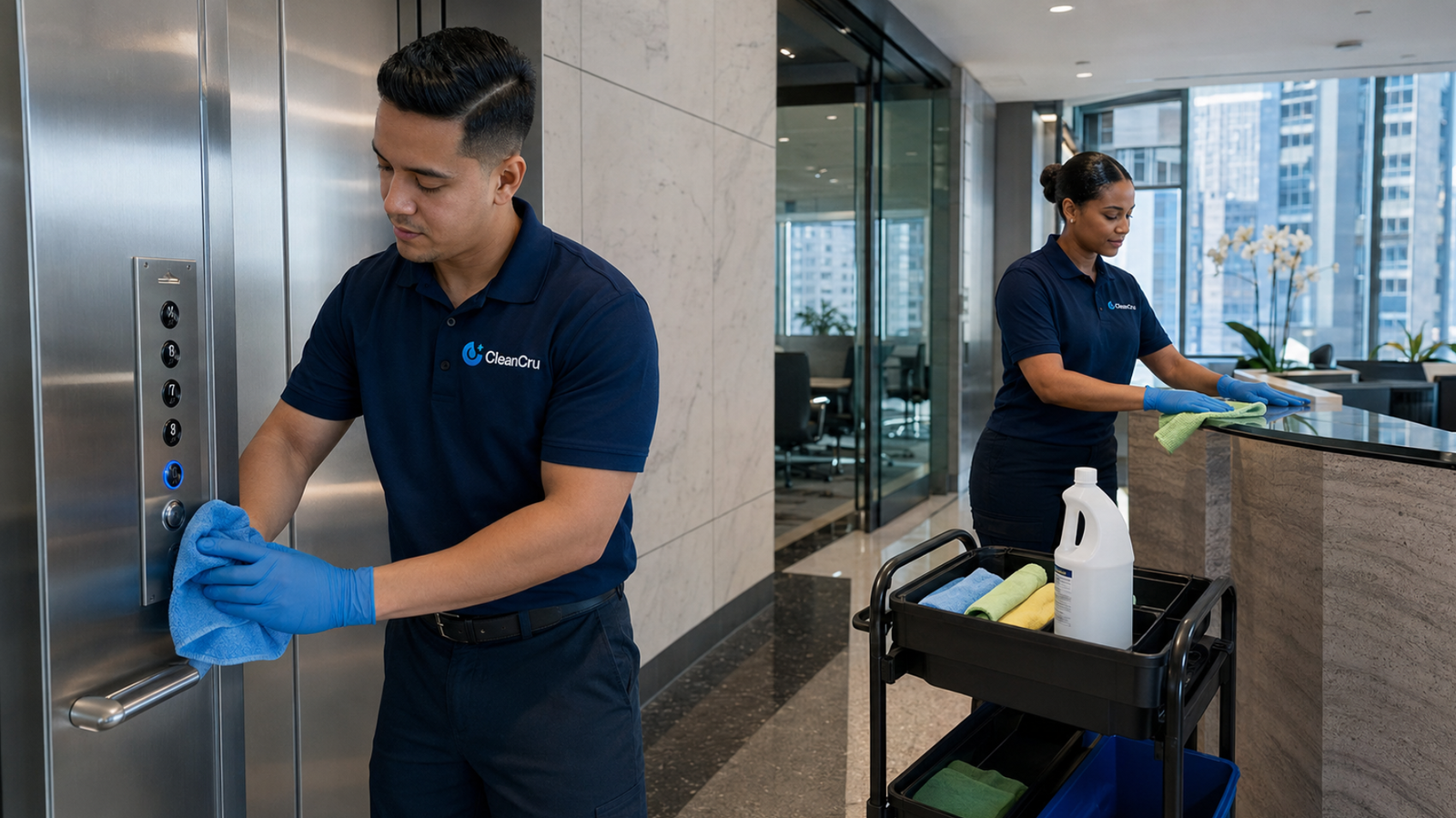
Decide whether you need nightly cleaning, a day porter or both. Nightly cleaning handles the full scope while the space is empty, while a day porter keeps lobbies, restrooms and break rooms fresh during business hours. Many commercial buildings use both.
A good cleaning program also schedules deeper work on a calendar so it happens on time. Ask whether the company will build a program for you, not just sell hours.
CleanCru starts with a free walkthrough, sends a written quote that lists every task and every visit, and assigns a consistent crew with one point of contact. Our commercial cleaning covers offices, medical facilities, retail, warehouses and multi tenant buildings across NYC. Contact us to compare our scope against any other bid you have.
Hiring a cleaning company is easier when you know the rules that apply to your building. These trusted resources cover chemical safety, disinfectant standards, business support and city services for New York City operators.
CleanCru is not affiliated with these organizations. Links are shared as helpful references for local businesses.
Every account gets a custom Scope of Work, GPS verified clock ins, photo proof, and a direct point of contact, not a call center.
Your checklist names the tasks done nightly, weekly and monthly, so you always know what was done and when.
Start with a walkthrough, ask for a written scope with task frequency, confirm insurance and compare consistency of crews. Price matters, but scope and reliability matter more.
Cost depends on square footage, visit frequency, floor types, restrooms and extras. A written quote after a walkthrough is the only reliable way to compare companies.
Be careful with long contracts and heavy cancellation fees before a company has proven itself. Ask for flexibility to adjust scope as your needs change.
Building management usually requires a certificate of insurance. Ask for it up front and confirm it meets your lease or building rules.
Many buildings use both. Nightly cleaning handles the full scope, while a day porter keeps restrooms, lobbies and break rooms fresh during the day.
After the walkthrough and written quote, most NYC locations can start within about a week, depending on scope and schedule.
Explore other CleanCru services that businesses often combine with regular commercial cleaning.
Contact CleanCru to schedule a free walkthrough and get a written quote you can compare against any other bid.